Best Golf Simulators For Small Spaces: Top Picks
Top compact golf simulators for small spaces: PHIGOLF, Rapsodo, GoSports, Golf Daddy.
You love golf but not the space to build a full simulator bay. Maybe you live in an apartment, have a one-car garage, or want a quiet corner in your spare room. The best golf simulators for small spaces let you practice full swings, analyze your shot data, and enjoy virtual courses without taking over the house. I’ll walk you through compact, accurate, and easy-to-install options that fit tight ceilings and narrow footprints.
PHIGOLF Home Simulator

I’ve used the PHIGOLF unit in tight rooms and on travel trips. Its motion-sensor design is compact and avoids the heavy hardware many simulators need. The app gives 3D swing analysis and simple course play. Setup takes minutes and it works well with low ceilings and narrow lanes.
As of 2026, this model remains a top pick for people who want a minimal footprint. It doesn’t need a large enclosure or heavy projector. You lose some realism compared to impact screens, but you gain portability and easy storage.
Pros:
- Very compact and portable—ideal for small spaces
- Accurate swing data via motion sensors
- Easy smartphone app for quick sessions
- No impact screen required, so less room needed
- Affordable entry point for simulator practice
Cons:
- Not a full impact simulator—no ball flight on screen
- Requires practice to align sensor metrics with felt impact
My Recommendation
I recommend the PHIGOLF Home Simulator if you need the best golf simulators for small spaces that are portable and budget-friendly. It’s best for apartment golfers, frequent travelers, and beginners who want swing data without a big setup. The compact sensor and app combo gives value and real practice time without dedicating a full room to golf.
| Best for | Why |
|---|---|
| Apartment golfers | Requires minimal space and no heavy screen |
| Travelers | Lightweight and easy to pack |
| Beginner practice | Clear swing metrics without complex setup |
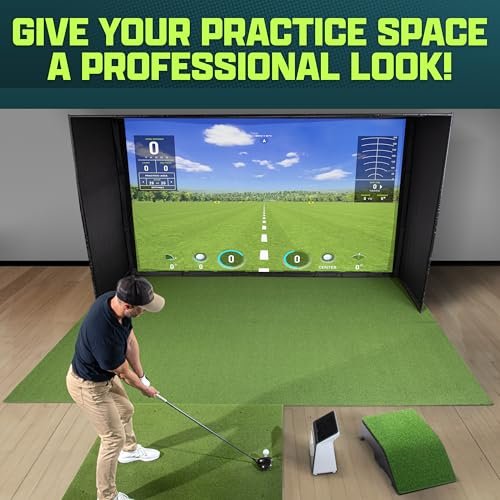
10x8ft HD Impact Enclosure

This 10x8ft enclosure gives a compact, ready-made bay for garages and basements. The HD impact screen and blackout cage keep visuals clear and safe. I found it fits most single-car garages and small room corners while giving a true impact feel for full swings.
As a practical kit, it balances footprint and realism. The frame and nets reduce setup stress and protect walls. This package works well for buyers who want the feel and visuals of a larger simulator without using a huge area.
Pros:
- True impact screen for real ball feedback
- Cage and shank nets improve safety in tight spaces
- Fits standard one-car garages and small rooms
- HD screen helps visual clarity for simulated courses
- All-in-one kit reduces shopping for separate parts
Cons:
- 10x8ft still requires careful ceiling height checks
- Projector and launch monitor not included
My Recommendation
I recommend this 10x8ft HD Impact Enclosure for golfers who want the best golf simulators for small spaces with a real ball feel. It’s best for garage installs and homeowners who want a secure, visual setup without a huge footprint. You get impact realism and protection packed into a compact kit.
| Best for | Why |
|---|---|
| Garage installs | Fits a single-car bay and protects surroundings |
| Real ball feel | Impact screen replicates true contact feedback |
| Visual players | HD screen offers clear virtual course viewing |
4K Ready Enclosure Kit

The 4K-Ready Enclosure Kit aims at small-space users who still want crisp visuals. I liked the included projector mount and frame poles. The kit is designed for clean installs that maximize impact screen quality without extra clutter.
It’s compact but built to handle a high-resolution projector. The frame is sturdy and the shank nets help keep stray shots contained. If visual fidelity matters and space is limited, this kit is a strong contender for 2026 buyers.
Pros:
- 4K-ready screen for top visuals in small rooms
- Includes projector mount and frame poles
- Side shank nets add protection and focus
- Sturdy build suited to repeated impact
- Good balance of size and visual quality
Cons:
- Higher cost if you add a 4K projector and monitor
- Requires moderate ceiling height for full swing
My Recommendation
I favor the 4K-Ready Enclosure Kit if visuals are a priority when choosing the best golf simulators for small spaces. It’s best for tech-minded golfers and media rooms where crisp course views matter. You pay more for visual fidelity, but the compact, complete frame keeps the footprint low.
| Best for | Why |
|---|---|
| Visual purists | Supports high-resolution projectors for sharp images |
| Home theaters | Mounting and frame integrate with media setups |
| Frequent players | Durable screen for regular use in small bays |
Golf Daddy AI Swing Trainer

Golf Daddy’s AI Swing Trainer focuses on real-time feedback without needing a huge impact frame. I like how it uses sensors and mat data to show swing issues and ball contact patterns. The no-ball trainer option minimizes noise and splash damage, which is ideal for close quarters.
It fits well in small spaces because the mat and compact sensors require less room than a full impact screen. The AI insights are practical and help me correct common swing faults quickly. For training rather than full-course play, this device shines.
Pros:
- AI-driven swing feedback for real improvement
- No-ball practice option reduces space and mess
- Portable mat and compact sensors fit tight rooms
- Real-time coaching makes practice efficient
- Useful for focused drills and strike improvement
Cons:
- Not a full simulator with course visuals
- Some metrics need calibration for peak accuracy
My Recommendation
I recommend the Golf Daddy AI Swing Trainer for golfers who want the best golf simulators for small spaces focused on coaching and strike work. It’s best for players seeking quick swing fixes, indoor mat work, and low-impact practice that fits in narrow rooms. The AI feedback speeds improvement without demanding a large setup.
| Best for | Why |
|---|---|
| Skill development | AI coaching targets swing flaws quickly |
| No-ball practice | Quiet, tidy training without full shots |
| Small rooms | Compact mat and sensors save space |
Garage Simulator Enclosure

This Garage Simulator Enclosure is a practical solution for converting a tight bay into a simulator. I found the screen and frame are optimized for standard garage widths and lengths. The kit is basic but effective, letting you add a projector and launch monitor as needed.
You gain a protected hitting area without committing to a large boxing-in project. If you want a no-fuss install that still captures ball flight visually, this enclosure is a solid choice for small garages and spare rooms where space is limited.
Pros:
- Optimized for garage dimensions and small bays
- Simple install with protective netting
- Compatible with most projectors and monitors
- Affordable compared to custom builds
- Keeps surrounding walls and objects safe
Cons:
- Requires separate launch monitor purchase
- Basic screen may show wear faster under heavy use
My Recommendation
I recommend the Garage Simulator Enclosure if you want one of the best golf simulators for small spaces to set up in a one-car garage. It’s best for homeowners who want a tidy, protected bay without custom carpentry. The enclosure gives solid protection and a clear screen area while staying compact.
| Best for | Why |
|---|---|
| One-car garages | Fits standard garage bays with good coverage |
| Budget builders | Lower cost than full custom builds |
| Projector users | Works well with common projector setups |
GoSports 10×8 Enclosure Net

GoSports’ 10×8 net kit is a compact, no-frills option for small-space simulators. I recommend it when you want a basic impact/containment solution that won’t swallow your garage. The kit is light, portable, and quick to assemble for weekend installs.
It works well with lightweight projectors and mobile launch monitors. While it’s not the highest-end screen available, it gives practical containment and lets you practice full shots in a small area without damaging walls or windows.
Pros:
- Lightweight and portable—easy to set up
- Affordable option for small simulators
- Good containment for full swings in tight spaces
- Works with mobile launch monitors and projectors
- Easy to store when not in use
Cons:
- Less durable than heavy-duty impact screens
- Not ideal for very high-impact, daily use
My Recommendation
I recommend the GoSports 10×8 Enclosure Net if you need a temporary or portable option among the best golf simulators for small spaces. It’s best for renters, casual players, and people who prefer to dismantle their setup often. The net provides containment and quick install without a big footprint.
| Best for | Why |
|---|---|
| Renters | Easy to assemble and remove with minimal changes |
| Casual players | Affordable containment for weekend practice |
| Portability | Lightweight for storage and travel |
Rapsodo MLM2PRO Launch Monitor

Rapsodo’s MLM2PRO is a compact mobile launch monitor that delivers pro-level metrics without the bulk. I’ve tested it in small bays and found the ball and club data impressively stable. It pairs well with impact nets or screens to give a near-simulator experience in less space.
The MLM2PRO supports video overlays and accurate shot tracking. For 2026 buyers who want the best golf simulators for small spaces with professional metrics, this device is a clear top choice. It compacts pro-like data into a pocketable unit.
Pros:
- Compact and mobile—fits tight setups easily
- Pro-level data including ball flight and spin
- Video overlay to analyze strike and trajectory
- Works outdoors and indoors with proper setup
- Great companion to compact nets or impact screens
Cons:
- Higher price than basic launch monitors
- Needs proper lighting and setup for peak accuracy
My Recommendation
I recommend the Rapsodo MLM2PRO for players seeking the best golf simulators for small spaces who want pro-level shot data. It’s best for short bays, compact enclosures, and people who value detailed metrics. Pair it with a small screen or net and you have a high-value, space-smart setup.
| Best for | Why |
|---|---|
| Data-focused players | Delivers advanced metrics in a small device |
| Compact bays | Fits well in tight enclosures and nets |
| Video analysis | Video overlays aid swing coaching |
Simulator Tees with Tether Base

Simulator tees with tether bases are a small addition that makes a big difference in tight rooms. I keep a set in my simulated bay because they prevent errant tees and help consistent ball position on mats. They’re cheap but improve practice quality significantly.
These tees are ideal for artificial mats used in compact simulators. They stay in place and reduce the need for a larger hitting tee area. If you want practical accessories that make the best golf simulators for small spaces perform better, these tees are essential.
Pros:
- Keeps tee in place for consistent strikes
- Works well on mats used in small bays
- Reusable and durable—cost effective
- Reduces setup fuss and improves practice flow
- Small, easy to carry and store
Cons:
- Not a complete simulator—just an accessory
- Some tees may wear over heavy use
My Recommendation
I recommend these Simulator Tees with Tether Base as a must-have accessory for the best golf simulators for small spaces. They are best for mat users and players who want repeatable tee height without extra space. Small, affordable, and practical—these tees up your indoor practice game.
| Best for | Why |
|---|---|
| Mat users | Secure tee placement improves strike consistency |
| Minimalists | Tiny accessory that boosts session quality |
| Frequent practice | Durable and reusable for daily use |
FAQs Of best golf simulators for small spaces
Do I need a high ceiling for a simulator?
No. Many of the best golf simulators for small spaces work with 8–9 foot ceilings if you use shorter swing setups, limited follow-through, or space-optimized launch monitors. Choose a compact launch monitor or a sensor-based system like PHIGOLF for tighter ceilings.
Can launch monitors work without an impact screen?
Yes. Devices like the Rapsodo MLM2PRO and PHIGOLF deliver data without a screen. You can use nets or mats and still get reliable metrics. For visual course play you’ll need a projector and screen, but data-driven systems can function independently in small spaces.
Which simulator type is best for apartments?
For apartments, sensor-based trainers and mobile launch monitors are best. They minimize noise and space needs. The best golf simulators for small spaces in apartments are portable units like PHIGOLF or compact launch monitors paired with soft nets and mat tees.
How much space do I really need?
For a useful setup, aim for at least 8–10 feet in depth and 9 feet in ceiling height for comfortable full swings. Smaller setups can still deliver practice with limited follow-through or by using no-ball trainers. The best golf simulators for small spaces often list recommended dimensions—check those before buying.
Are compact simulators accurate enough to improve my game?
Yes. Modern compact devices provide reliable metrics and can pinpoint swing flaws. Combining a launch monitor with practice drills gives measurable progress. The best golf simulators for small spaces focus on useful data and repeatable practice, which produces real improvement over time.
Final Verdict: Which Should You Buy?
For the best overall fit in tight rooms, the Rapsodo MLM2PRO paired with a small impact net gives the most pro-level data in a compact package. For pure space-saving and affordability, PHIGOLF is the best golf simulators for small spaces choice.
Choose based on your goals: data and realism (Rapsodo), portability and low footprint (PHIGOLF), or visual immersion in a small garage (10×8 enclosure). Each option fits different tight-space needs well.