What Does E Mean On Golf Leaderboard: Simple Guide
On a golf leaderboard in the United States, E means “even par.” It means the player has used the same number of strokes as the course’s par for the holes counted.
For example, if a player completes a par-72 tournament in 72 strokes, the leaderboard may show E, Even, or 0. These all mean the same thing: the player is neither under nor over par.
The letter E does not mean the player shot an eagle. On a leaderboard, it is a score-to-par symbol.

What does even par mean in golf?
Even par means a golfer has matched the course’s expected score. Each golf course gives every hole a par value. The total of those hole values creates the course par.
A standard 18-hole course often has a par of 70, 71, or 72. If the course is par 72:
- 72 strokes means E
- 71 strokes means -1
- 70 strokes means -2
- 73 strokes means +1
- 74 strokes means +2
Par is not a promise that every golfer should finish in that number of strokes. It is a scoring standard based on the length and design of the holes.
The United States Golf Association, or USGA, defines par as the score a scratch player is expected to need for a hole or course under normal conditions. Professional tournaments use this system to compare players on the same course.
Simple example
Imagine a player’s score after 18 holes is 72 on a par-72 course:
| Player score | Course par | Leaderboard score |
|---|---|---|
| 72 | 72 | E |
| 71 | 72 | -1 |
| 70 | 72 | -2 |
| 73 | 72 | +1 |
| 74 | 72 | +2 |
The player at E is not leading if other golfers are under par. A player at -4 is four strokes ahead of a player at E, assuming both have played the same number of holes.

How is E calculated on a golf leaderboard?
A leaderboard calculates a player’s score compared with par. The basic formula is:
Score to par = strokes taken − par for the holes played
If the result is zero, the leaderboard displays E.
Full-round calculation
Suppose a golfer plays a par-72 course and shoots 76:
76 − 72 = +4
The leaderboard shows +4.
If another golfer shoots 68:
68 − 72 = −4
The leaderboard shows -4.
A golfer who shoots 72 has this result:
72 − 72 = 0
The leaderboard may display E instead of 0.
During a tournament round
The calculation can also apply before a player finishes the round. Suppose a player has completed 12 holes on a course where those holes add up to par 48. If the player has used 48 strokes, the score is E for those holes.
If the player has used 46 strokes, the score is -2. If the player has used 50 strokes, the score is +2.
This is why a live leaderboard can change after nearly every hole.

Does E mean the player is tied for first?
No. E only describes a player’s score relative to par. It does not show the player’s position by itself.
A player at even par could be:
- Leading the tournament
– Tied for 10th - Near the cut line
- Well behind the leader
- The last player on the leaderboard
The player’s position depends on the scores of everyone else and how many holes they have played.
Example leaderboard
| Position | Player | Score to par |
|---|---|---|
| 1 | Player A | -6 |
| 2 | Player B | -4 |
| T3 | Player C | E |
| T3 | Player D | E |
| 5 | Player E | +1 |
In this example, Players C and D are tied for third among the players shown, even though they are at even par. Their position comes from comparing their scores with the rest of the field.
A leaderboard may also show a player as T15, which means tied for 15th. The T means “tied.” The E in a score column means “even par.” They have different meanings.
What do the other golf leaderboard symbols mean?
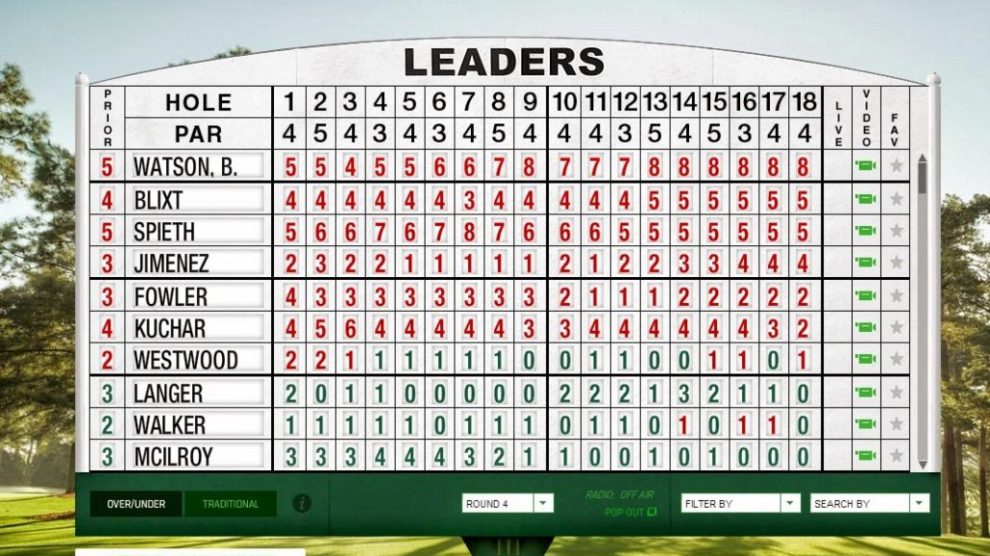
Most golf leaderboards use a small group of standard score symbols.
| Symbol | Meaning | Example |
|---|---|---|
| E | Even par | The player matches par |
| -1 | One under par | One stroke better than par |
| -3 | Three under par | Three strokes better than par |
| +1 | One over par | One stroke worse than par |
| CUT | Did not make the cut | The player cannot continue |
| WD | Withdrew | The player left the event |
| DQ | Disqualified | The player was removed under event rules |
| T | Tied position | T5 means tied for fifth |
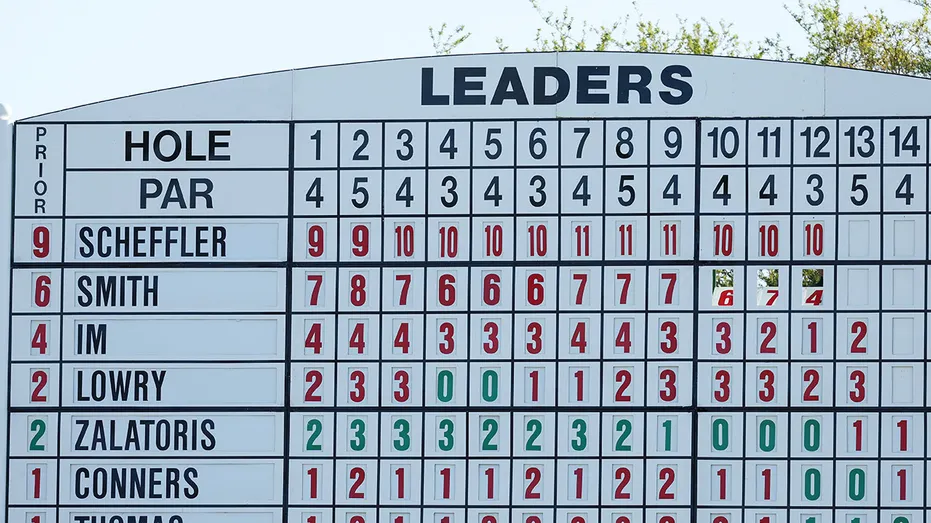
Some sites show under-par scores in red and over-par scores in black or another color. Color is a design choice, so the number or symbol is the safer guide.
What does “AS” mean?
In match play, a leaderboard may use AS, which means all square. This means the match is tied after the holes played.
That is different from E in stroke play:
- E means even par against the course.
- AS means tied against an opponent or team.
A tournament may also show thru 7, F, or a similar status:
- Thru 7 means the player has completed seven holes.
- F means the player has finished the round.
- A dash or blank may mean the player has not started or the data is not available.

Why does a player show E after only a few holes?
A player can show E before finishing 18 holes because leaderboard scores are based on the holes already completed.
For example, consider the first six holes:
- Hole 1: par 4
- Hole 2: par 4
- Hole 3: par 3
- Hole 4: par 5
- Hole 5: par 4
- Hole 6: par 4
The total par for those holes is 24. If the player takes 24 strokes, the live leaderboard shows E.
The player has not necessarily finished the round at even par. The score can change on the remaining holes.
Why a player may move while still showing E
A player’s position can change even when the score remains E. Other golfers may move under or over par, causing the player to rise or fall on the leaderboard without changing their own score.
For example, a player at E may move from 20th to 15th if several players behind them make bogeys. The player did not improve, but the field changed.

Is E good or bad on a golf leaderboard?
E can be good or bad depending on the course, weather, tournament, and field. Even par is a neutral score compared with par, but its value changes from event to event.
At a difficult U.S. Open setup, even par may place a golfer near the top. At an easy PGA Tour or LPGA Tour event, even par may leave a player far behind the leader.
Other factors also matter:
- Wind and rain can make scoring harder.
- Firm greens can increase the number of difficult putts.
- Course length affects approach shots and club selection.
- The strength of the tournament field changes the likely winning score.
- A player’s position relative to the cut line affects whether E is useful or dangerous.
A player at E after the first round may still have a strong chance to win. A player at E late in the final round may be several strokes behind the leader.
The best way to judge an even-par score is to compare it with the leader’s score, the cut line, and the number of holes remaining.
E versus an eagle: what is the difference?
E on a leaderboard means even par. An eagle is a score of two under par on one hole.
These terms look similar but describe different things:
- Even par: A player’s total score matches the course par.
- Eagle: A player scores two strokes under the par for a single hole.
For example, a golfer who makes an eagle on a par-5 scores a 3 on that hole. That improves the player’s overall tournament score by two strokes compared with par for that hole.
A golfer could make an eagle and still finish the round at E. That might happen if the player also makes two bogeys elsewhere.
The usual scorecard marks for individual holes include:
- Birdie: One under par
- Eagle: Two under par
- Albatross or double eagle: Three under par
- Par: The expected score for the hole
- Bogey: One over par
- Double bogey: Two over par
The leaderboard’s E symbol summarizes the total score relative to par. It does not describe one specific hole.

Common mistakes when reading E on a golf leaderboard
The most common mistake is treating E as a player’s raw stroke total. It is not. It is a comparison between strokes taken and the par value for the holes played.
Other mistakes include:
Mistaking E for a tie
E does not mean the golfer is tied. Check the position column and look for a T before the position number.
Comparing players who have played different numbers of holes
A golfer at -3 through 15 holes and a golfer at -3 after finishing 18 holes may not be in the same position once the first player completes the round.
Ignoring the course or holes played
Even par for 18 holes is not the same as even par through nine holes. The par for the holes completed is the correct baseline.
Assuming E has the same value in every event
Even par may be a strong score on one course and a weak score on another. Always check the event conditions.
Confusing stroke play with match play
Stroke-play leaderboards compare total strokes to par. Match-play displays may use terms such as AS, 1 UP, or 2 DOWN to show the state of a head-to-head match.
Frequently asked questions
What does E mean in golf scoring?
E means even par. The player has taken the same number of strokes as the par for the holes counted.
Is E better than +1?
Yes. E is one stroke better than +1 because even par is zero relative to the course, while +1 is one over par.
Is E better than -1?
No. A score of -1 is one stroke under par, so it is better than E.
What does E mean after 9 holes?
It means the player is even par for the nine holes completed. The player has matched the total par for those nine holes.
Can E mean even for the whole tournament?
Yes. If a player finishes a multi-round event with the same total number of strokes as the total tournament par, the final score may show E.
For a 72-hole event with a par of 72 each round, the total par is 288. A player who shoots 288 is even par for the tournament.
Why does a leaderboard show E instead of 0?
E is a common golf abbreviation for even par. Some leaderboards use 0, while others use E or EVEN. The meaning is the same when the score column compares a player with par.
Bottom line
On a U.S. golf leaderboard, E means even par. The player has matched the expected par score for the holes played.
It does not mean first place, a tie, or an eagle. To understand what the score means in context, compare E with the leader’s score, the cut line, the player’s position, and the number of holes completed.