What Golf Shoes Are Made In The USA: Best American Brands
Golf shoes made in the USA are uncommon, but they do exist. Most golf shoes sold in the United States are made overseas, even when the company is American. A small group of makers has produced golf shoes in American factories or workshops, often using handsewn methods and domestic labor.
The key is to separate three claims: an American brand, an American-designed shoe, and a shoe made in the USA. They are not the same. A shoe may carry a U.S. brand name while its upper, sole, or full assembly comes from another country.
For golfers, the country of manufacture matters less than fit, grip, comfort, weather use, and walking support. Still, knowing what “Made in USA” means can help beginners, junior families, walking golfers, and players who care about domestic craftsmanship make sense of confusing labels.

Quick answer: Which golf shoes are made in the USA?
A limited number of golf shoes have been made in the USA by small makers such as rancourt & Co. and MacNeill Golf, while some historic FootJoy golf models were also made in American facilities. Availability and country-of-origin labels can change by model and production run. Always check the exact shoe label, box, or manufacturer statement rather than assuming that an American brand makes every shoe in the United States.

The strongest current examples are usually small-batch, handsewn, or custom golf shoes. Large golf brands may have a long American history but still manufacture most present-day footwear abroad.
Here is the basic distinction:
| Label or claim | What it usually means | What it does not prove |
|---|---|---|
| American brand | The company began in, or operates from, the United States | The shoe was made in the United States |
| Designed in USA | Design work took place in the United States | The materials and assembly are domestic |
| Assembled in USA | Major assembly happened in the United States | Every component came from the United States |
| Made in USA | The maker claims the product meets U.S. origin rules | Every raw material is necessarily American |
| Handcrafted in USA | Much of the work was done by hand in a U.S. workshop | The sole, leather, or hardware is domestic |
The Federal Trade Commission uses standards for unqualified “Made in USA” claims. A manufacturer should be able to explain the claim and identify the production location. If the wording is unclear, treat it as a question to verify, not as proof.
Documented American-made golf shoe examples
The best-known American-made examples come from smaller footwear companies and older premium lines. Their status can change, so the exact model and production date matter.

Rancourt & Co. golf shoes
Rancourt & Co. is a Maine-based shoemaker known for handsewn footwear. The company has offered golf shoes made in Maine, including models built with traditional moccasin and handsewn construction.
This type of shoe often uses a leather upper, a stitched or handsewn moccasin-style base, and a sole designed for traction. The construction can feel flexible underfoot, which may suit a golfer who walks and values natural movement.
A Rancourt golf shoe may not feel like a modern athletic trainer. It can have a more structured leather feel and may need a break-in period. That point matters for a senior golfer, a player with a wide forefoot, or anyone walking 18 holes for the first time.
MacNeill Golf
MacNeill Golf has been associated with handmade golf shoes produced in the United States. Its footwear has focused on classic leather construction and custom-style craftsmanship rather than mass-market athletic production.
Small makers may offer more control over leather, stitching, width, and shape. They also tend to produce fewer models and fewer sizes than large golf brands. A junior golfer or a player with a fast-growing foot may need a different approach than an adult who wants a long-term leather shoe.
Because small businesses can change production methods, confirm the current origin for the exact model. A company’s history is useful, but it is not a permanent guarantee about every new shoe.
Historic FootJoy American-made models
FootJoy has a long American footwear history, and some older FootJoy golf shoes were made in the United States. The FootJoy Classics line is often discussed in this context because of its traditional leather construction and American manufacturing history.
That does not mean all FootJoy shoes, or all current Classics-style shoes, are made in the USA. Large footwear companies often use several factories and countries. A model name can remain familiar while the factory location changes.
Collectors, resale listings, and old advertisements may describe historical production. Those sources can help identify older shoes, but they should not replace the country-of-origin label on the actual pair.
| Example or category | U.S. connection | Main caution |
|---|---|---|
| Rancourt & Co. golf footwear | Maine-based handsewn production has included golf shoes | Confirm the exact model and current production |
| MacNeill Golf | Known for handmade American golf footwear | Small-maker production can change |
| Older FootJoy Classics | Some historic models were made in American facilities | Current and older models may differ |
| American golf brand | Company or design may be U.S.-based | The shoe may be imported |
| Custom American shoemaker | May build golf footwear in a U.S. workshop | A custom shoe may not use all-U.S. materials |
The main takeaway is simple: small American makers are the clearest place to find domestic golf footwear, while older large-brand models require careful identification. A brand’s reputation alone is not enough.
Why “made in the USA” is hard to define
“Made in the USA” is a country-of-origin claim, not a statement about grip, comfort, or playing quality. A shoe can be excellent and imported, or American-made and poorly suited to a player’s foot.

A golf shoe has many parts. These include the upper, lining, insole, midsole, outsole, laces, eyelets, waterproof membrane, traction elements, and adhesive. A U.S. workshop may assemble the shoe while some of those parts come from other countries.
The most useful question is not only “Where is the brand from?” Ask, “Where was this exact model cut, stitched, assembled, and finished?”
| Shoe part | What it does on the course | Why origin can vary |
|---|---|---|
| Upper | Holds the foot and resists water, dust, and wear | Leather or synthetic material may come from another country |
| Insole | Adds cushioning and shapes foot contact | Often made by a specialist supplier |
| Midsole | Absorbs impact during walking and the swing | Foam compounds are widely sourced |
| Outsole | Creates contact with turf | Rubber and molded compounds may be imported |
| Traction pieces | Help resist sliding during the downswing | Spikes or lugs may come from another supplier |
| Lining and laces | Improve comfort and hold the foot | These parts often have separate origins |
A label such as “Made in USA of imported materials” is different from an unqualified “Made in USA” claim. The first tells you that final production occurred in the United States but that some or many materials came from elsewhere.
Brand origin versus factory origin
A company may be headquartered in Massachusetts, Maine, Oregon, or California and still use a factory in Asia, Europe, or Latin America. This is common in footwear because shoe production requires specialized equipment, trained workers, and supply chains.
The same brand may also use more than one factory. One model may be made in the United States, another in Portugal, and another in Vietnam. The country can even differ between sizes or production years in rare cases.
For beginners, this is not a reason to feel lost. Read the label, learn the terms, and focus on the fit and function that suit your golf.
Why small makers are more likely to make shoes domestically
Small American shoemakers often use methods that fit workshop production. These include handsewn moccasin construction, stitched welts, leather cutting, and bench finishing.
Large athletic golf shoes need high-volume molding and assembly. A small workshop may not make that type of shoe, but it can produce a leather golf shoe in limited runs.
That difference affects the feel. A handsewn leather shoe may bend more naturally, while a molded athletic shoe may feel lighter and more cushioned. Neither style suits every golfer.
💡 Pro Tip: If country of origin matters to you, record the exact model name, model code, and country label. This is more reliable than a brand’s general “American made” story.
How American-made golf shoes differ from imported golf shoes
The main difference is usually production location and construction method, not automatic performance. American-made golf shoes often come from smaller workshops, while imported golf shoes may come from high-volume factories with advanced athletic tooling.
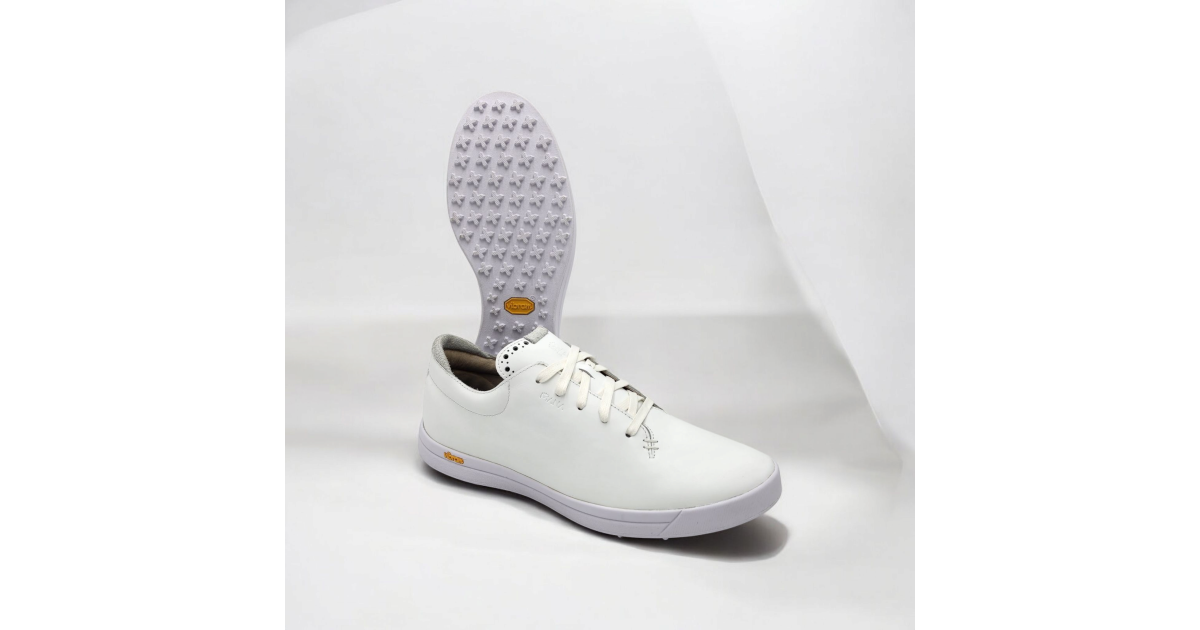
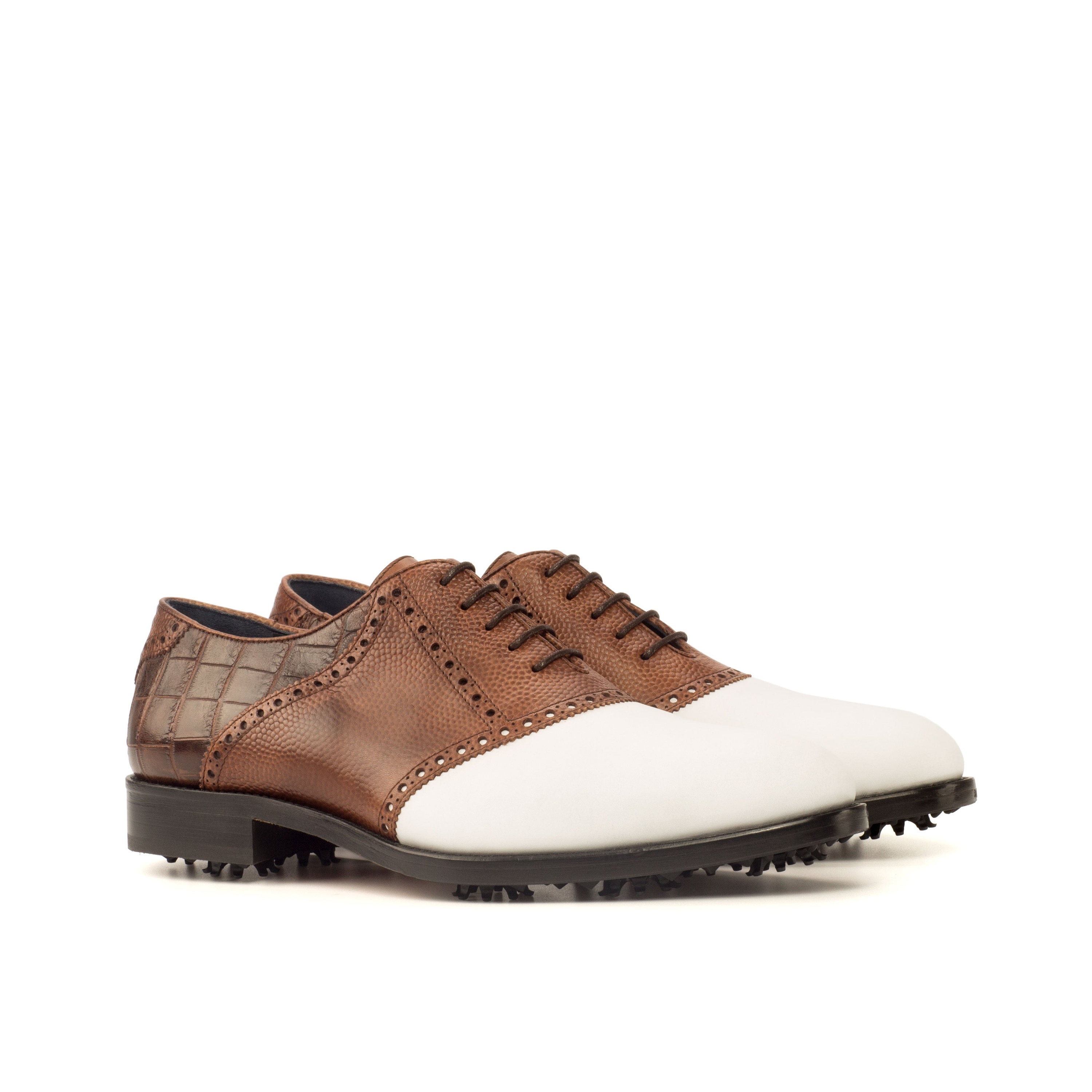
A traditional American-made golf shoe may use full-grain leather. Full-grain leather is the outer layer of the hide, so it can develop a patina and resist wear when cared for well. It may also feel firm at first and less breathable than mesh.
Modern imported models often use engineered mesh, synthetic leather, foam midsoles, and molded rubber. These materials can reduce weight and improve ventilation. A golfer who walks in hot, humid weather may prefer those traits.
| Construction style | Typical feel | Golfer it may suit |
|---|---|---|
| Traditional leather | Stable, firm, and structured | Walkers who like classic support |
| Handsewn moccasin | Flexible and natural under the foot | Players who value foot movement |
| Athletic mesh | Light and breathable | Hot-weather walkers and juniors |
| Waterproof leather | Protected but warmer | Wet climates and early-morning rounds |
| Molded synthetic | Consistent and easy to clean | Beginners and frequent players |
The country of manufacture does not decide whether a shoe is right for a left-handed or right-handed player. Golf shoes are not built for swing direction. Fit, stance comfort, and traction matter for both groups.
Traction and the golf swing
During the swing, the feet help transfer force from the ground. A right-handed player often pushes from the trail foot and turns around the lead foot. A left-handed player does the same actions on the opposite sides.
Good traction can help a golfer keep balance during the backswing, downswing, and follow-through. It does not correct a slice, hook, poor posture, or weak grip. Footwear supports movement; it does not replace sound instruction.
A shoe with aggressive lugs may grip well on wet turf but feel less smooth on a hard cart path. A spikeless sole may feel easy for walking between the tee box, fairway, rough, and clubhouse. Course conditions should guide the choice.
Comfort during walking and riding
A walking golfer may spend four or more hours on the course. The shoe must support the heel, midfoot, and forefoot over a long period. A rider still walks from the cart to the ball, so comfort matters even when the cart does most of the travel.
Golf fitness also affects footwear needs. A golfer with stiff ankles, weak calves, or a history of plantar foot pain may need a stable shoe and a gradual walking plan. Persistent pain is a health issue, not a footwear problem to ignore.
American-made golf shoes by golfer type
The best golf shoe depends on the player, not only the country on the label. A beginner has different needs from a low-handicap player, and a junior has different needs from a senior.

Beginners and new golfers
New golfers often spend more time walking, learning stance width, and building balance. A shoe with steady traction and a comfortable fit can help them focus on posture, grip, alignment, and tempo.
A traditional leather shoe may suit a beginner who likes a firm, stable feel. It may not suit a beginner who plays in hot weather or has no time for a break-in period.
For a new golfer, the most important checks are simple:
- The heel stays in place during the swing.
- The toes can spread without pressure.
- The sole feels stable on grass.
- The shoe does not cause rubbing.
- The player can walk comfortably for several hours.
Improving amateurs
Improving players may notice how the shoe behaves during impact. A stable base can help them repeat pressure shifts and maintain balance. Yet a shoe cannot create clubhead speed or fix an over-the-top downswing.
A golfer working on chipping, pitching, bunker shots, or putting may value a flexible forefoot. A golfer working on a powerful driver swing may prefer more lateral support. The right answer depends on movement, foot shape, and course conditions.
Handicap index can offer context, but it does not determine shoe choice. A 25-handicap player may walk every round, while a 5-handicap player may ride. Their needs can be opposite.
Seniors
Senior golfers may benefit from easy walking, stable footing, and enough room for natural swelling during a long round. Stiff leather can feel secure, but it may bother a player with limited ankle movement.
A senior golfer with back, knee, or foot pain should speak with a medical professional. Pain that changes a walking pattern can affect posture and swing mechanics. Do not use a golf shoe to mask a worsening injury.
Women golfers
Women’s feet often differ in heel shape, forefoot width, and overall proportions, but there is no single “women’s foot.” Fit should come before a gender label.
A golfer who has a narrow heel may need strong heel hold. Another may need more forefoot space. The best test is how the foot feels during a walk, a practice swing, and a full round.
Junior golfers
Junior golfers need shoes that match their current foot size and activity. A shoe that is too large can allow the foot to slide during the downswing. That can reduce balance and create blisters.
Parents should also check that junior shoes work on grass, practice mats, and wet paths. Children grow quickly, so comfort and safe movement matter more than a long break-in period.
👪 Parent or Beginner Note: A child should not wear a stiff adult golf shoe simply because it looks durable. Junior feet need room to move, and a secure fit supports balance during early lessons.
| Golfer | Useful priority | Possible limitation |
|---|---|---|
| Beginner | Comfort, balance, and simple traction | Highly rigid shoes may distract from learning |
| Improving amateur | Lateral stability and repeatable foot pressure | Aggressive traction may feel harsh on firm turf |
| Senior golfer | Walking comfort and easy flex | Very soft shoes may lack needed support |
| Woman golfer | Heel hold and foot-specific fit | Gender labels do not describe every foot |
| Junior golfer | Secure fit, light weight, and safe movement | Fast growth can make long-term fit difficult |
| Frequent walker | Cushioning, breathability, and weather protection | Heavy leather may add fatigue |
The takeaway is clear: American manufacture is one feature. Foot shape, age, walking habits, climate, and course type usually matter more for daily comfort.
What to check before calling a golf shoe American-made
A careful verification process prevents common mistakes. Use the shoe itself, the manufacturer’s statement, and the production details.

Read the country-of-origin label
Look inside the shoe, on the tongue, under the insole, on the box, or on the product information supplied by the maker. The wording may say “Made in USA,” “Made in USA of imported materials,” or “Imported.”
Do not confuse a U.S. flag, an American town name, or “since 19—” with a manufacturing claim. Those details describe identity or history, not necessarily production.
Check the exact model
A company may make one golf shoe in the United States and another abroad. The same brand can also release a limited run that differs from its main line.
Model names can remain in use for years. Check the code or production information where possible. This is especially important with older FootJoy or other classic golf shoes found through secondhand channels.
Ask about assembly and materials
A useful question is: “Where are the cutting, stitching, lasting, sole attachment, and finishing completed?” Lasting is the process of shaping the upper around the shoe form.
You can also ask whether the shoe is made in a U.S. factory or a small workshop. A clear answer is stronger than a vague statement about American design.
Understand “component” claims
Some companies identify an American leather supplier or an American sole maker. That is useful information, but it does not prove that the complete golf shoe was made in the United States.
| Verification step | Strong evidence | Weak evidence |
|---|---|---|
| Read label | Clear country-of-origin statement | U.S. flag or city name |
| Identify model | Exact model and production details | Brand reputation alone |
| Ask maker | Specific factory or workshop answer | “American quality” wording |
| Check materials | Clear source for key components | One domestic component |
| Compare records | Label matches company statement | Old advertisement only |
Take two lessons from this table. First, the exact model matters. Second, a production claim should be clear enough for a customer or rules official to understand.
Made in USA versus assembled in USA
“Made in USA” and “assembled in USA” are not equal claims. The first suggests that the product meets a broader domestic-content standard, while the second focuses on the final assembly location.

A golf shoe marked “assembled in USA” may have an imported outsole, lining, leather, or traction unit. It can still involve American labor and skill. It simply does not make the same origin claim as an unqualified “Made in USA” label.
A shoe marked “Made in USA of imported materials” also gives useful detail. It tells you that the final product is made domestically while some materials come from another country.
Why the distinction matters
Some readers care about domestic jobs. Others care about local craft, supply chains, durability, or environmental impact. The label helps them understand the product, but it does not answer every question.
Country of origin also does not tell you how a shoe performs on a links course, an executive course, or a wet parkland course. Course management, footing, and pace of play still matter more during a round.
Why claims can change
Factories change. Suppliers change. A brand may move a model to another country, bring it back for a limited run, or use different factories for different sizes.
Rules and labeling guidance can also change. For current information, check the latest Federal Trade Commission guidance and the manufacturer’s current statement.
📜 Check the Rules: Golf footwear generally does not need approval like a club or ball, but a tournament or club may have dress or spike policies. Check the latest Rules of Golf and local committee rules before competition.
Do U.S.-made golf shoes follow golf rules?
Golf shoes made in the USA follow the same course rules as other golf shoes. The Rules of Golf do not give a special advantage to shoes because of where they were made.
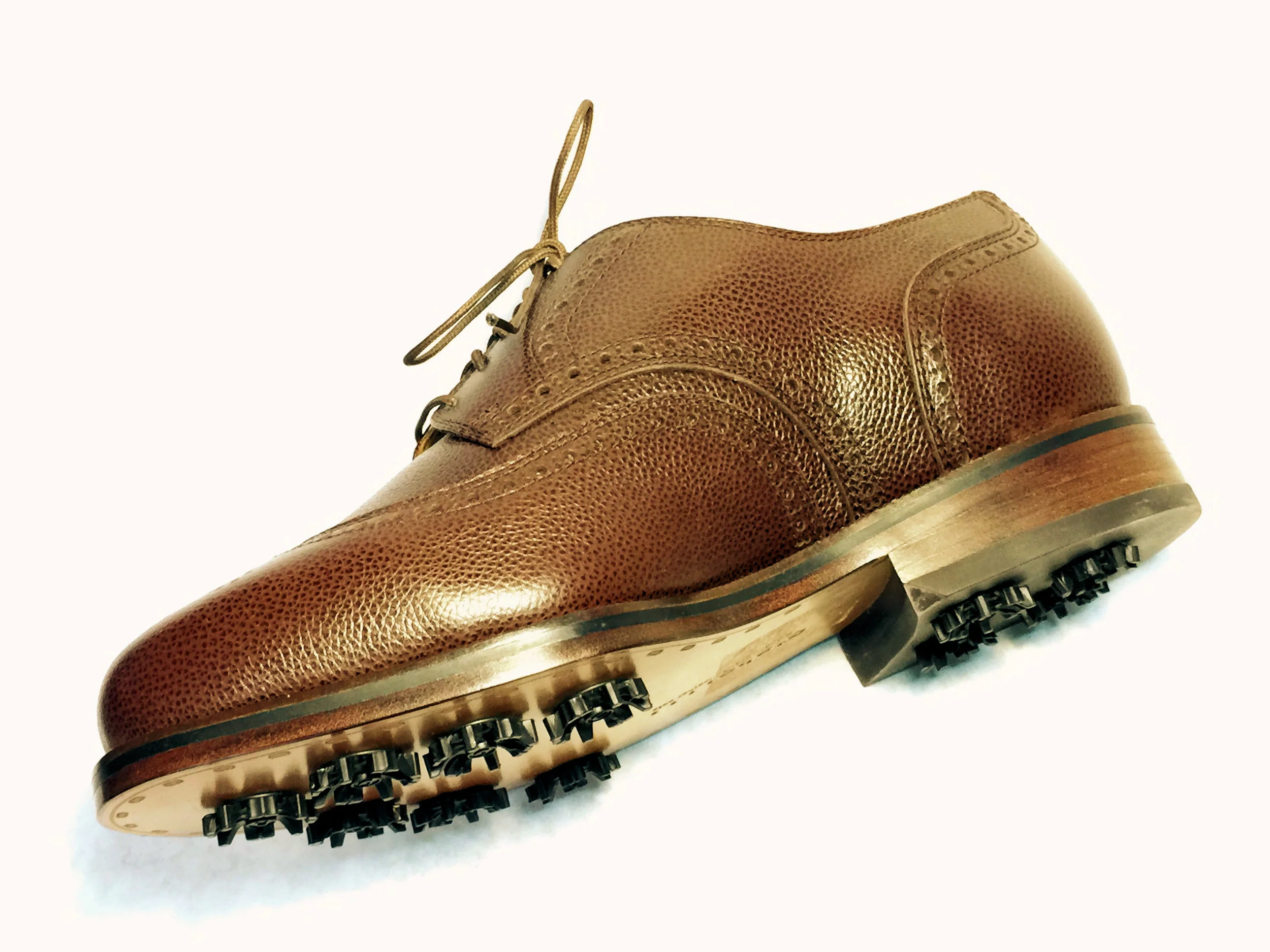
The main concerns are safety, course care, and local policy. Shoes should not damage putting greens, create unsafe footing, or violate a club’s dress code. A committee may set local requirements for spikes, soft spikes, or other footwear.
A player should repair ball marks, replace divots, rake bunkers, and avoid dragging feet across a green. These duties apply whether the shoe is leather, mesh, spiked, or spikeless.
Spikes, traction, and green care
Traditional metal spikes are restricted or banned at many facilities because they can damage greens. Modern soft spikes and molded soles are more common, but local rules still control.
Do not test traction by twisting hard on a green. Walk carefully, avoid unnecessary steps near the hole, and leave the putting surface as you found it.
Match play and stroke play
The footwear origin does not change scoring in stroke play, match play, Stableford, or a scramble. Stroke play counts the total score over the round or event. Match play compares holes won, and Stableford awards points based on performance against par.
If a shoe causes damage or violates a local rule, the committee handles the matter. Ask the professional shop or tournament committee before play if the policy is unclear.
| Situation | Good practice | Why it matters |
|---|---|---|
| Putting green | Walk softly and repair marks | Protects the surface |
| Bunker | Enter at the low side when possible and rake | Restores the hazard for the next player |
| Wet turf | Avoid needless traffic near sensitive areas | Reduces soil compaction |
| Spiked footwear | Follow the facility’s spike policy | Supports safety and course care |
| Tournament | Check local conditions of competition | Prevents avoidable disputes |
The rule takeaway is simple: origin does not create a rules advantage. Local footwear policies and course-care duties apply to everyone.
How climate and course type affect American-made golf shoes
Weather can change how a golf shoe feels and performs. Leather, mesh, waterproof membranes, and traction patterns each respond differently to heat, rain, cold, and firm ground.

Wet and cool conditions
A waterproof leather shoe can help keep feet dry in rain or morning dew. It may feel warmer and less flexible than a ventilated shoe.
Wet grass also raises slipping risk. Walk with shorter steps, keep the knees soft, and avoid sudden turns. A good shoe helps, but no sole can make every slope safe.
Hot and humid conditions
Mesh or perforated panels allow more airflow. This can suit a golfer walking an exposed course in summer. However, more airflow can mean less protection in heavy rain.
Hydration, sun protection, and rest matter as much as footwear in hot weather. Stop play at the first lightning warning and leave the course for a safe shelter.
Links courses and firm ground
A links course often has firm, rolling ground and exposed wind. A flexible shoe can feel natural over uneven turf, but the outsole still needs enough lateral support.
On firm ground, a very aggressive sole may feel harsh. On soft turf, a smooth sole may slip. Check the surface before choosing footwear for practice or play.
Carts, paths, and clubhouse areas
Riding does not remove the need for a stable shoe. Cart users still walk over slopes, wet grass, bridges, and rough.
Some traditional golf shoes can mark floors or feel awkward on hard paths. Follow clubhouse and cart-path rules, and avoid driving carts on restricted areas.
| Condition | Shoe feature that can help | Other adjustment |
|---|---|---|
| Heavy rain | Water-resistant upper and secure traction | Shorten steps and avoid steep wet slopes |
| Hot weather | Breathable upper and light construction | Drink water and use sun protection |
| Cold morning | Warm lining and stable outsole | Warm up before full swings |
| Firm links turf | Flexible sole with controlled grip | Keep balance on uneven ground |
| Soft wet fairway | Strong lateral traction | Avoid unnecessary cart traffic |
| Long walking round | Cushioning and secure heel hold | Build walking distance gradually |
No shoe replaces sound weather judgment. If lightning, extreme heat, or unsafe flooding affects the course, stop play and follow the facility’s warning system.
Pros and cons of American-made golf shoes
American-made golf shoes offer real strengths, but they also have limits. An honest comparison helps golfers judge the idea without turning country of origin into a quality promise.
| Potential advantage | Potential limitation |
|---|---|
| Supports domestic craft and labor | Fewer models and sizes may be available |
| Often uses careful hand construction | Break-in may take time |
| Can offer classic leather feel | Leather may feel warmer than mesh |
| Production details may be easier to trace | Small makers may change output |
| May allow custom-style work | A custom fit still needs careful measurement |
| Strong connection to footwear history | American origin does not ensure ideal traction |
For a new golfer, the main advantage may be craftsmanship. The main limitation may be weight or break-in time. For a frequent walker, comfort over four hours matters more than the label.
For a senior golfer or someone with foot pain, test the shoe slowly. A professional fitting or medical opinion may be more useful than a country claim. For a junior, growth and secure fit usually come first.
Common mistakes when researching U.S.-made golf shoes
Many errors come from treating marketing language as a full production record. These mistakes are easy to avoid.

Mistaking an American logo for American production
An eagle, flag, state outline, or American town name can suggest heritage. It does not prove where the shoe was made.
Assuming every model from one brand has the same origin
Factories differ by line and season. Check each model.
Treating old information as current
A golf shoe from ten years ago may have a different origin from a newer version with the same name. Vintage descriptions can be accurate for the old pair and wrong for the new one.
Ignoring foot function
A domestic shoe can still be too narrow, too stiff, too heavy, or too slippery for a player. Fit is part of performance.
Forgetting course rules
A traditional outsole may not suit a facility with strict spike rules. Ask before a tournament or club event.
| Common mistake | Better approach |
|---|---|
| Trusting the flag on the label | Find the country-of-origin statement |
| Relying on brand history | Check the exact model |
| Using an old review | Confirm current production |
| Choosing by origin alone | Test fit, flex, grip, and walking comfort |
| Ignoring local policy | Ask the course or committee |
The best research is calm and specific. Country of origin is one fact in a larger footwear decision.
A simple checklist for identifying American-made golf shoes
Use this checklist when reading a label or manufacturer statement. It works for beginners, experienced golfers, parents, and collectors.

- Find the exact model name and number.
- Read the country-of-origin label.
- Separate “brand,” “designed,” “assembled,” and “made.”
- Check whether the claim applies to the current model.
- Ask where cutting, stitching, lasting, and sole attachment occur.
- Note whether materials are domestic, imported, or mixed.
- Check the sole for safe traction on the course you play.
- Walk and swing in the shoes before a full round.
- Confirm local spike and dress rules.
- Stop using the shoes if they cause pain or change your gait.
A short test can reveal a lot. Walk on level ground, climb a gentle slope, make a slow practice swing, and check whether the heel lifts or the toes press forward.
Signs of a good fit
The heel should stay secure without painful pressure. The toes should have room to move, and the arch should feel supported rather than forced.
The shoe should bend where your foot bends. It should not fold sharply under the middle of the arch. Try both shoes, since left and right feet are often slightly different.
Signs the shoe may not suit you
Blisters, numb toes, heel slipping, sharp arch pressure, and knee or back discomfort are warning signs. A golfer with recurring pain should see a doctor or qualified health professional.
A PGA professional can help when footwear problems affect stance, balance, or swing practice. A golf-specific physical therapist or fitter may also help identify movement limits.
⚠️ Safety Warning: Warm up before full swings, especially in cold weather. If you feel sharp pain in the foot, ankle, knee, back, wrist, or elbow, stop. Do not try to swing through pain.
Frequently asked questions
Q: Are all Rancourt golf shoes made in the USA?
A: Rancourt & Co. is a Maine-based shoemaker and has offered golf shoes made in Maine. Confirm the exact model and current production details because product lines and manufacturing claims can change.
Q: Are MacNeill Golf shoes made in America?
A: MacNeill Golf has been associated with handmade golf shoes produced in the United States. Check the current model information and country-of-origin statement for the specific shoe.
Q: Are FootJoy golf shoes made in the USA?
A: Some historic FootJoy models, including older Classics models, were made in American facilities. FootJoy has also used overseas production, so do not assume that every current or older pair is American-made.
Q: Does an American brand mean the shoe is made in America?
A: No. An American brand may design, market, or sell a shoe in the United States while using an overseas factory. Read the exact country-of-origin label.
Q: Are American-made golf shoes better?
A: Not automatically. They may offer careful leather work or handsewn construction, but performance depends on fit, traction, flex, weather protection, and walking comfort.
Q: Are U.S.-made golf shoes good for seniors?
A: They can be, if the shape, weight, flex, and support suit the golfer. Seniors with foot, knee, or back pain should address the health issue and avoid shoes that change their walking pattern.
Q: Are American-made golf shoes suitable for women?
A: Yes, if the shoe fits the individual foot. Heel shape, forefoot width, arch comfort, and toe room matter more than the gender label.
Q: Can juniors wear American-made golf shoes?
A: Yes, but secure fit and safe movement come first. Junior golfers should not wear shoes that are too large or too stiff, even if the shoes are well made.
Q: Do left-handed golfers need different golf shoes?
A: No. Golf shoes are not made for a swing direction. Both left- and right-handed players need stable traction and a comfortable fit.
Q: Do American-made golf shoes work on wet courses?
A: They can, depending on the upper, lining, outsole, and condition of the leather. Check for water resistance and traction, then use safe walking habits on wet slopes.
Q: Can golf shoes made in the USA be worn off the course?
A: Some spikeless shoes are designed for limited walking away from the course, but local policies and the outsole shape matter. Traditional spikes may damage floors or be unsuitable indoors.
Q: Do golf shoes affect handicap index?
A: Shoes do not directly affect handicap index. A handicap index reflects scoring under the World Handicap System, using factors such as score differentials and course rating and slope. Footwear can affect comfort and balance, but it does not change the calculation.
Q: How long does it take to break in leather golf shoes?
A: It varies by leather, construction, foot shape, and use. Wear them for short walks before a full round. A shoe that causes pain during a short walk is unlikely to become suitable through forced break-in.
Q: Are golf shoes required under the Rules of Golf?
A: The Rules of Golf do not generally require one specific shoe type. Clubs and tournament committees may set dress or footwear policies. Check the current local rules and conditions of competition.
Q: Where can I verify a Made in USA claim?
A: Start with the shoe label and the manufacturer’s current statement. For general labeling guidance, check the latest Federal Trade Commission information. For event rules, check the current committee notice.
Final thoughts
Golf shoes made in the USA are a small but meaningful part of golf footwear history. The clearest examples tend to come from American handsewn or custom makers, while older models from major brands may reflect a different manufacturing era.
The most reliable method is to verify the exact model. Look for the country-of-origin statement, separate American branding from American production, and ask where the main construction steps take place.
Then judge the shoe as a piece of golf equipment. It should support a steady stance, safe traction, comfortable walking, and good course care. For a beginner, that may make lessons more enjoyable. For an improving player, it may support balance during the swing. For a senior, woman, junior, or frequent walker, the right fit can make the round feel less demanding.
Country of origin tells part of the story. Your feet, your course, your climate, and your health tell the rest.