What Golf Shoes Are Not Made In China: Best Brands To Consider
Golf shoes made outside China do exist, but the answer is not as simple as naming one brand. Golf footwear often comes from several factories at once. A single brand may use factories in Vietnam, Thailand, Indonesia, Portugal, Slovakia, Italy, Taiwan, or China. The country can also change by model, color, size, season, or production run.
The most reliable answer is on the shoe’s country-of-origin label. Look inside the tongue, under the insole, on the box, or on the manufacturer’s product page. Terms such as “Made in Vietnam,” “Made in Portugal,” or “Made in Thailand” identify the final manufacturing country. “Designed in the USA” does not mean the shoe was made in the United States.

Quick answer: Which golf shoes are not made in China?
Golf shoes that are labeled Made in Vietnam, Made in Thailand, Made in Indonesia, Made in Portugal, Made in Slovakia, Made in Italy, Made in Taiwan, or Made in the USA are not made in China. Some golf footwear lines from ECCO, FootJoy, Nike, adidas, PUMA, TRUE linkswear, New Balance, and other brands have used non-Chinese factories for certain models, but no brand-wide rule applies to every shoe. Check the exact model label because country of origin can vary.

The key point is simple: a brand name is not proof of a shoe’s manufacturing country. A model from a familiar company may be made in China, while another model from the same company may be made in Vietnam or Europe.
The term “country of origin” usually means where the final substantial manufacturing took place. It does not always show where the leather, rubber, foam, laces, spikes, or waterproof membrane came from. Several countries may supply parts before the shoe receives its final assembly.
Countries commonly used for golf shoe production
Golf shoes made outside China may come from many manufacturing regions. Vietnam and Indonesia are major footwear centers. Thailand, Taiwan, Portugal, Slovakia, and Italy also produce some performance footwear.
| Label on the shoe | What it usually means | What it does not prove |
|---|---|---|
| Made in Vietnam | Final qualifying production took place in Vietnam | Every material came from Vietnam |
| Made in Thailand | Final qualifying production took place in Thailand | The brand is Thai-owned |
| Made in Portugal | Final qualifying production took place in Portugal | All leather came from Portugal |
| Made in USA | The product meets the applicable U.S. origin claim standard | Every small component came from the United States |
A non-Chinese label answers the origin question for that pair. It does not prove better grip, longer life, comfort, or waterproof performance. Those features depend on design, materials, fit, care, and course conditions.
Why country of origin matters to golfers
Country of origin matters for supply-chain awareness, personal values, customs information, and product traceability. It can also matter when a golfer needs to confirm what a school, club, event, employer, or team permits.
For beginners, the label can be confusing because “designed in,” “engineered in,” and “assembled in” may appear beside “made in.” These phrases describe different parts of the process. A golfer who wants to avoid Chinese manufacturing should focus on the final country-of-origin statement, not the design address.
For improving players, origin can help with record keeping. If a shoe is repaired, replaced under a policy, or compared with another model, the exact model code and factory label can identify the production version. This is useful because two shoes with nearly identical names may come from different countries.
For parents and junior golfers, the label may help confirm team or school requirements. Junior shoes also need the right size, firm heel hold, and suitable traction. Country of origin should not replace checks for fit, walking comfort, and safety.

“Designed in” versus “made in”
“Designed in the United States” describes design work. It does not mean the shoe was manufactured in the United States. “Engineered in Germany” describes technical development, while the shoe may still be made in Vietnam, Thailand, Indonesia, or China.
“Imported” is also not the same as “made in China.” Imported simply means the product entered the country from another country. A shoe made in Portugal can be imported into the United States.
| Wording | Plain meaning | Use for origin research |
|---|---|---|
| Designed in | The design work was done in that place | Not enough to identify manufacturing |
| Assembled in | Parts were joined in that place | May not equal a full “Made in” claim |
| Made in | The product meets the country’s origin standard | Strongest label to check |
| Imported by | A company brought the item into a market | Does not identify the factory country |
The safest approach is to record the exact wording, model number, and manufacturing country. Do not treat a flag, company headquarters, or design slogan as a factory statement.
Golf shoe brands and non-Chinese manufacturing
Several large golf footwear brands have used factories outside China for some golf shoe models. This does not mean all of their shoes are made outside China. Manufacturing changes over time, and public brand information may describe a region rather than one model.
ECCO has used production facilities in Europe and Asia, including Portugal, Slovakia, Thailand, and Indonesia for different footwear lines. Some golf shoes may carry a European or Asian origin label. The exact pair still needs checking.
FootJoy has used a global supply chain. Some footwear models have been made in China, Vietnam, or other countries. A FootJoy brand name alone cannot answer the question.
Nike, adidas, and PUMA also use global footwear networks. Golf models from these companies may be made in Vietnam, Indonesia, China, or other locations. The model label is more useful than the logo.
TRUE linkswear has also used overseas manufacturing for its footwear. The country can vary by model and production run. A company’s design story does not replace the origin label.
New Balance has made some footwear in the United States and other countries. Its “Made in USA” claim applies only to specific products that meet the company’s stated criteria. It should never be extended to every New Balance golf shoe.
| Brand or brand group | Non-Chinese countries that may appear on some footwear | Important limit |
|---|---|---|
| ECCO | Portugal, Slovakia, Thailand, Indonesia | Country varies by model and line |
| FootJoy | Vietnam and other countries | Many models use different factories |
| Nike | Vietnam, Indonesia, and other countries | Golf models can differ from general footwear |
| adidas | Vietnam, Indonesia, and other countries | A brand headquarters does not show origin |
| PUMA | Vietnam and other countries | Check the exact golf shoe |
| New Balance | United States and other countries | “Made in USA” is model-specific |
| TRUE linkswear | Various overseas locations | Confirm the pair’s label |
This table is a research starting point, not a permanent list. A factory contract can change. A model can move from one country to another without a visible change in its name.
Why brand lists can become outdated
Footwear companies manage factories based on capacity, materials, labor, shipping, technical skills, and demand. A waterproof shoe may use one factory, while a lightweight spikeless shoe uses another. A junior shoe may come from a different country than a men’s or women’s model.
The same model name can also have different labels in different markets. A pair made for the United States may not share the same origin as a pair made for Europe or Asia.
⚠️ Safety and accuracy warning: Do not rely on an old list, social-media post, or marketplace description when the origin matters. Check the current label on the exact shoe and confirm with the manufacturer if the wording is unclear.

How to verify that golf shoes are not made in China
The best way to verify origin is to inspect the physical product. Online descriptions can be incomplete. Product photographs may show a sample pair from a different production run.
Start with the inside of the tongue. Many golf shoes print or sew the country statement there. If the tongue has no label, check under the insole, along the inside sidewall, or on the box label.
Next, find the model code. It may include letters and numbers near the size chart. Record that code with the country statement. A model code gives the manufacturer a better way to confirm the exact production version.
Then compare the label with the official product information. The official page may list “country of origin,” “imported,” or a similar field. If the page only says “designed in,” it has not answered the manufacturing question.

A simple five-step origin check
- Locate the country label. Check the tongue, insole, box, and care label.
- Write down the exact wording. “Made in Vietnam” is different from “designed in the USA.”
- Record the model number. Include the size and color if shown.
- Compare official sources. Look for the country-of-origin field from the brand.
- Ask for clarification. Contact the manufacturer when the label and website conflict.
This method suits all golfers. Beginners can use it without knowing footwear terms. Experienced players can add the model code to their equipment records.
| Where to look | Why it helps | Common problem |
|---|---|---|
| Tongue label | Often carries size and origin details | Text may fade or be hidden |
| Insole underside | May show factory information | Removing the insole can damage it |
| Shoe box | Often lists origin and model code | The box may not match the pair |
| Official product page | Can confirm model details | Web pages may change |
| Manufacturer support | Best for unclear cases | A reply may require the exact code |
Take photographs before discarding packaging. Keep the origin label and model code together. This can prevent confusion when similar shoes use different factories.
What “made in China” means for golf shoes
“Made in China” identifies the country where the shoe received its qualifying final production. It does not, by itself, describe quality, safety, comfort, or performance. A country label is a supply-chain fact, not a score for the shoe.
China has a large and skilled footwear industry. Many golf shoes made there use advanced waterproof materials, molded midsoles, rubber compounds, and traction systems. Golfers should separate origin questions from performance questions.
The same rule applies to shoes made elsewhere. “Made in Vietnam” does not guarantee better grip. “Made in Italy” does not guarantee a better fit. Grip comes from the outsole pattern and rubber compound. Fit comes from shape, width, upper construction, and lacing. Walking comfort depends on the whole shoe and the golfer’s foot.

Components may come from several countries
A golf shoe may have leather from one country, mesh from another, rubber from a third, and final assembly in a fourth. The label normally identifies the country of final qualifying production rather than every component source.
This matters for golfers who want a fully non-Chinese supply chain. A shoe made in Vietnam may still contain materials or parts sourced from China. Public labels often do not give a complete component map.
Ask the manufacturer a precise question if this level of detail matters: “Where was this model finally manufactured, and are any major components sourced from China?” The answer may be limited because companies do not always publish supplier information.
| Golf shoe part | What it affects on course | Origin may differ from the shoe |
|---|---|---|
| Outsole and lugs | Traction on turf and wet grass | Rubber compound may come from another country |
| Midsole foam | Cushioning and walking comfort | Foam materials may have a separate source |
| Upper | Water resistance, breathability, fit | Leather or mesh can be imported |
| Insole | Underfoot feel and support | May be produced separately |
| Laces and hardware | Fit adjustment and durability | Usually have separate suppliers |
The practical takeaway is clear. A non-Chinese final assembly label does not prove that every part avoided China. It does answer the narrower question of where the completed shoe was made.
Non-Chinese golf shoes by manufacturing region
Golfers often search by region because a country label is easier to understand than a brand history. The regions below are examples of places that have produced golf or performance footwear. They are not guarantees for every model.
Vietnam is one of the most common sources of modern athletic footwear. Golf shoes made there may use knit uppers, synthetic leather, waterproof membranes, molded foam, or rubber outsoles.
Thailand and Indonesia also have deep footwear experience. These countries may produce golf shoes with traditional leather uppers, spikeless traction, or technical athletic designs.
Portugal, Slovakia, and Italy are important European footwear locations. European-made shoes may use leather construction or specialized factory processes, but the label alone does not prove that the shoe suits every foot or course.
The United States produces some footwear, including limited “Made in USA” lines. A domestic-origin claim has a specific legal meaning and may allow some imported components. Read the exact claim rather than assuming every part is domestic.

Common regional labels
| Region or country | Golf shoe features that may appear | Verification point |
|---|---|---|
| Vietnam | Lightweight mesh, synthetic uppers, molded traction | Check the exact model label |
| Indonesia | Leather and performance footwear | Country can differ by production run |
| Thailand | Athletic and leather footwear | Confirm the pair, not only the brand |
| Portugal | European leather and specialty footwear | “Designed in Europe” is not enough |
| Slovakia | European factory production | Check for the “Made in” statement |
| Italy | Specialty leather and premium footwear production | Origin does not define fit |
| United States | Certain domestic-origin footwear lines | Claim may allow imported components |
A region can explain where a shoe was made, but it cannot answer whether the shoe fits a wide foot, supports a senior golfer, or handles a wet links course. Those are separate questions.
Golf shoe origin and course performance
Country of origin does not determine how a golf shoe performs. Course type, weather, walking distance, and swing movement matter more.
A golfer on a wet links course needs stable traction and water resistance. A golfer on a dry executive course may care more about low weight and flexible walking comfort. A player who rides in a cart still needs secure footing during the downswing, especially on slopes and wet turf.
Spiked and spikeless designs also create different trade-offs. Spiked shoes use replaceable or fixed traction elements. Spikeless shoes use molded lugs or patterns. Neither category is tied to one country.
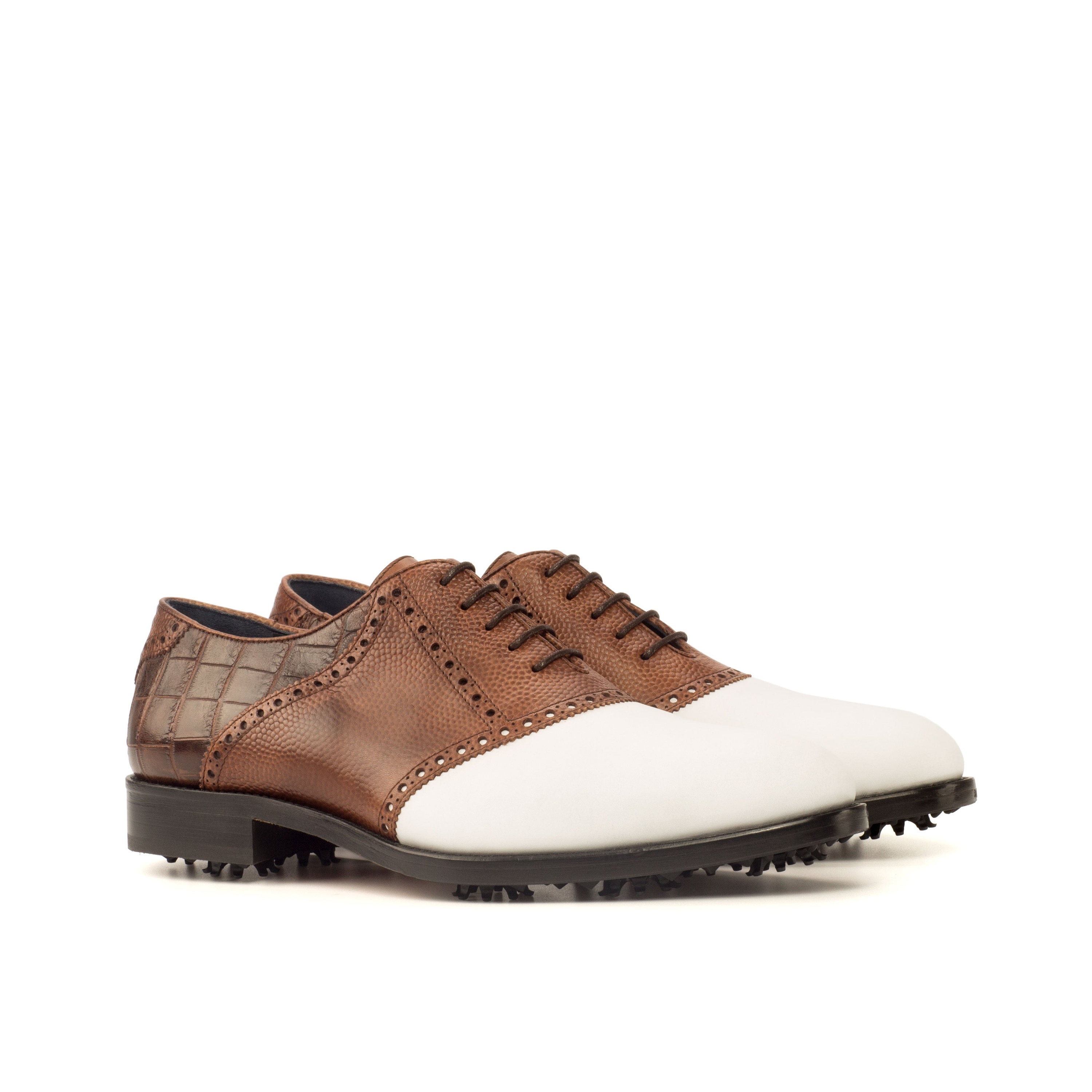
Matching footwear needs to the round
| Golfer or setting | Main shoe need | Origin question to ask |
|---|---|---|
| Beginner walking nine holes | Comfort, secure fit, basic traction | Is the exact pair made outside China? |
| Senior golfer | Cushioning, stable heel, easy fit | Does the label match the model information? |
| Junior golfer | Correct size, flexible fit, safe traction | Is the shoe made for the child’s foot size? |
| Wet links course | Water resistance and grip | Where was the final waterproof construction done? |
| Hot, dry course | Breathability and walking comfort | Does the upper use materials from several countries? |
| Hilly course | Lateral stability and outsole grip | Is the traction suitable for slopes? |
A shoe can be made outside China and still be a poor match for the golfer. A stiff upper may bother a junior. A narrow toe box may cause pain for a wide-foot player. A smooth outsole may feel unsafe on wet grass.
Walking, riding, and foot health
Walking golfers place many steps on the shoe. Their feet may swell during a four-hour round. A shoe that feels fine for ten minutes in a store or at home may feel different after several miles.
Riding golfers still need stable footing. The swing creates force through the feet, knees, hips, and trunk. Good posture and a balanced finish are easier when the shoe holds the turf without painful pressure.
Seniors and golfers returning from injury should pay close attention to foot comfort. Pain in the foot can change stance width, balance, posture, and swing tempo. Persistent pain needs medical advice, not a change in swing alone.
💡 Pro Tip: Test a golf shoe with the same socks used on the course. Walk, make slow practice swings, and hold a balanced finish. This checks comfort and stability without confusing country of origin with fit.
Golf shoe materials and labels
Golf footwear labels can include several terms that sound similar. “Leather upper” describes the material on top of the shoe. “Waterproof” describes a performance claim that may depend on construction, membrane, seams, and care. Neither phrase identifies the manufacturing country.
A shoe can use leather from one country and be made in another. A waterproof membrane can come from a specialist supplier. Adhesives and stitching may also involve several factories.
The label may list synthetic materials, textile content, rubber, and other parts. These material statements help explain construction, but they do not replace the country-of-origin label.

Terms golfers often confuse
| Term | Meaning | Does it answer the China question? |
|---|---|---|
| Leather upper | The upper uses leather | No |
| Waterproof membrane | A layer helps limit water entry | No |
| Breathable mesh | Air can move through part of the upper | No |
| Imported | The item entered the market from abroad | No |
| Made in Vietnam | Final qualifying production occurred in Vietnam | Yes, for final origin |
| Made in USA | The product meets the applicable U.S. origin claim | Yes, with claim limits |
Read the label in full. A small line of text may provide more useful information than a large national flag printed on the box.
Origin checks for men’s, women’s, and junior golf shoes
Men’s, women’s, and junior golf shoes may use different lasts. A last is the mold that shapes the shoe. It affects toe room, width, arch position, heel shape, and overall fit.
These groups may also use different factories. A women’s shoe from one brand may be made in Vietnam, while the men’s version is made in China. A junior model may come from a separate production line.
Left- and right-handed golfers do not need different shoe construction based on hand preference. Golf shoes are usually made for either foot and are worn by both right- and left-handed players. The main concern is balanced traction during rotation.

Fit checks for different golfers
For beginners, the shoe should feel secure without crushing the toes. Beginners often walk more than expected because they search for balls, study the green, and move between practice areas.
For improving amateurs, check whether the heel stays in place during the backswing and downswing. A slipping heel can make a golfer tighten the grip, sway, or lose balance at impact.
For women, men, and seniors, width and foot shape matter more than a general gender label. Feet vary widely within every group. For juniors, allow room for natural movement but avoid excess length that causes tripping.
A country-of-origin check should never lead a golfer to ignore pain. Blisters, numbness, hot spots, and joint pain are signs to stop and assess the fit.
Origin and the Rules of Golf
The Rules of Golf do not generally require a golfer to wear shoes made in a particular country. They focus on playing the course, equipment rules, player conduct, and local conditions.
Golf shoes may have spikes or molded traction. The key concern is whether the footwear damages the putting green or violates a club or event policy. A committee may set local requirements for soft spikes, metal spikes, or dress standards.
Golfers should check the latest Rules of Golf and local committee instructions. A school, club, charity event, or professional tournament may add clothing or footwear rules within its event policy.

Practical rules and etiquette
Do not drag your feet across a putting green. Repair ball marks and avoid unnecessary damage near the hole. Keep pace of play, allow faster groups to play through when appropriate, and follow cart signs.
Spikes can collect mud. Clean them before entering a clubhouse or scoring area. Dispose of broken tees, packaging, and worn traction parts properly.
📜 Check the Rules: The country where a shoe was made is not normally a Rules of Golf issue. Traction type, course damage, dress codes, and local policies may be. Check the current rulebook and the event committee’s instructions.
Pros and limits of choosing non-Chinese-made golf shoes
Some golfers want a non-Chinese manufacturing country for ethical, political, environmental, family, or organizational reasons. That is a valid information need. The challenge is that origin alone gives only one part of the supply-chain picture.
A non-Chinese final assembly label may make the answer clear at the product level. It may not reveal material sources, labor conditions, factory ownership, shipping routes, or environmental practices. Public information can be incomplete.
| Potential benefit | Limitation |
|---|---|
| Gives a clear final manufacturing country | Does not identify every component source |
| Helps meet a stated event or team requirement | Brand websites may become outdated |
| Supports supply-chain research | Country does not predict comfort or grip |
| Makes model comparison easier | Similar models may use different factories |
| Helps keep equipment records | Labels can vary by market and production run |
The best research habit is to ask a narrow question and keep evidence. “Where was this exact model made?” is more useful than “Where are all your shoes made?”
Common mistakes when searching for golf shoes not made in China
The most common mistake is treating a brand’s headquarters as the manufacturing country. A company may be based in the United States, Germany, Japan, or the United Kingdom while producing shoes across Asia and Europe.
Another mistake is trusting the country shown in a product title. Online sellers may list a shipping location, seller location, or brand origin instead of the factory country. A product photo may also show a different version.
A third mistake is assuming every model in a product family shares one factory. Golf footwear often has separate lines for spiked, spikeless, waterproof, wide, women’s, men’s, and junior designs.

Problems and better checks
| Common mistake | Why it fails | Better check |
|---|---|---|
| Using the brand headquarters | Headquarters is not a factory | Read the shoe label |
| Trusting a flag | A flag may show design identity | Find “Made in” wording |
| Checking only the box | The box may be mixed up | Match box and shoe codes |
| Assuming one brand has one origin | Models use different factories | Check each model |
| Treating “imported” as China | Imported covers many countries | Identify the stated country |
| Relying on an old list | Supply chains change | Confirm current information |
A careful answer may be less tidy than a brand list. It may say, “This model is made in Vietnam, but another model from the same brand is made elsewhere.” That is more accurate and more useful.
How origin affects golf equipment records
A simple equipment record can help golfers track country of origin without turning the process into guesswork. Write down the brand, model, model code, size, color, date found, and label wording.
This method suits parents managing junior equipment, golfers with club requirements, and anyone comparing production versions. It also helps when a model name stays the same but the factory changes.
Golfers who keep a handicap index or track fairways, greens in regulation, putting, and walking comfort can add footwear notes. Shoe comfort may affect practice time, balance, and confidence, even though it does not change the Rules of Golf.
A useful footwear record
- Brand and exact model
- Model or style code
- Men’s, women’s, or junior version
- Left and right size information
- Country-of-origin wording
- Spiked or spikeless design
- Waterproof or water-resistant claim
- Date and source of the label
The record should describe facts, not make unsupported claims. “Made in Vietnam” is a fact from the label. “Best for wet weather” is a performance judgment that needs more evidence.
Golf shoe care after checking the origin
Origin research does not protect a shoe from turf, mud, rain, or heat. Care affects how long the traction and upper remain useful.
Remove loose grass and soil after each round. Let wet shoes dry at room temperature. Avoid direct high heat, which can damage adhesives, leather, foam, and waterproof membranes.
For spiked shoes, check traction elements for wear. For spikeless shoes, inspect the molded lugs. Worn traction can affect balance during the swing, especially on wet slopes.
Care habits for walkers and riders
Walkers should check the heel lining and toe crease for early wear. Riders should still clean the outsole because mud can reduce traction when stepping onto slopes or wet grass.
Use suitable care methods for the upper material. Leather may need a product approved for that leather. Mesh usually needs gentle cleaning. Do not use harsh chemicals unless the manufacturer allows them.
🌿 Course Care Note: Clean mud before walking onto a green or tee box. Repair ball marks, replace divots where allowed, rake bunkers, and keep broken traction parts or packaging off the course.
How long does it take to confirm a golf shoe’s origin?
It often takes only a few minutes to inspect the label. More complex cases can take longer if the label is missing, the box is wrong, or the website gives only general supply-chain information.
A manufacturer may need the model code, size, color, and production details. A broad question about the brand may receive a broad answer. A precise question about one model usually creates a clearer record.
This process does not require advanced golf knowledge. Beginners, juniors, seniors, and experienced golfers can use the same steps. The difficult part is accepting that a brand-wide answer may not exist.
Frequently asked questions
Q: Are any golf shoes always made outside China?
A: It is difficult to say that a brand or product line is always made outside China. Factories and model sources can change. The exact pair’s “Made in” label is the strongest evidence.
Q: Are ECCO golf shoes made in China?
A: ECCO has used factories in several countries, including European and Asian locations. The country varies by model. Check the exact label rather than applying one answer to every ECCO golf shoe.
Q: Are FootJoy golf shoes made in China?
A: Some FootJoy models have been made in China, while others have used Vietnam and other countries. The brand name does not identify the origin of every pair.
Q: Are Nike golf shoes made in China?
A: Nike uses a global footwear supply chain. Some golf shoes may be made in Vietnam, Indonesia, China, or elsewhere. Check the model label.
Q: Are adidas golf shoes made outside China?
A: Some adidas golf footwear has been made in Vietnam, Indonesia, and other countries. The exact model and production run matter.
Q: Does “designed in the USA” mean made in the USA?
A: No. It describes design work, not final manufacturing. Look for a separate “Made in USA” statement.
Q: Does “imported” mean made in China?
A: No. Imported only means the product entered the market from another country. It could have been made in Vietnam, Portugal, Thailand, Indonesia, or another location.
Q: Can a golf shoe made in Vietnam contain Chinese materials?
A: Yes. The final manufacturing country and component sources can differ. Ask the manufacturer if a full component supply chain matters.
Q: Are golf shoes made in Europe better?
A: Country of origin does not prove comfort, grip, waterproofing, or durability. Fit, construction, outsole design, and care matter more for on-course use.
Q: Do men’s and women’s golf shoes from one brand have the same origin?
A: Not always. Different versions may use different factories. Check each model’s label.
Q: Do junior golf shoes come from different countries?
A: Yes. Junior footwear can use a separate production line. Check the child’s exact model and focus on fit, traction, and safe walking.
Q: Do left-handed golfers need different golf shoes?
A: No. Golf shoes are generally made for both feet. Left- and right-handed players use the same footwear types.
Q: Do golf shoe origins affect handicap or scoring?
A: No. Country of origin does not affect handicap index, slope rating, par, birdie, bogey, stroke play, match play, scramble, or Stableford scoring. Comfort and traction may affect confidence, but the Rules remain the same.
Q: Can a golf club require shoes from a certain country?
A: A club or event may set dress or traction rules, but country-of-origin requirements are unusual. Ask the committee or organizer. Always check local rules.
Q: How can I confirm a missing label?
A: Record the model code and contact the manufacturer. Ask where that exact model was finally manufactured. Do not assume the answer from the company headquarters or design location.
Q: Does waterproofing show where the shoe was made?
A: No. Waterproof construction may use materials from several countries. The origin label identifies the final qualifying manufacturing country.
Final thoughts
The clearest answer to “what golf shoes are not made in China?” is this: look for the exact pair labeled Made in Vietnam, Thailand, Indonesia, Portugal, Slovakia, Italy, Taiwan, or the United States. Some models from major golf footwear brands have used these countries, but no brand-wide claim is dependable for every model.
Treat country of origin as one fact in a larger picture. Check the model code, label, material wording, fit, traction, walking comfort, weather needs, and local event rules. A careful label check gives a more accurate answer than a permanent list of brands.